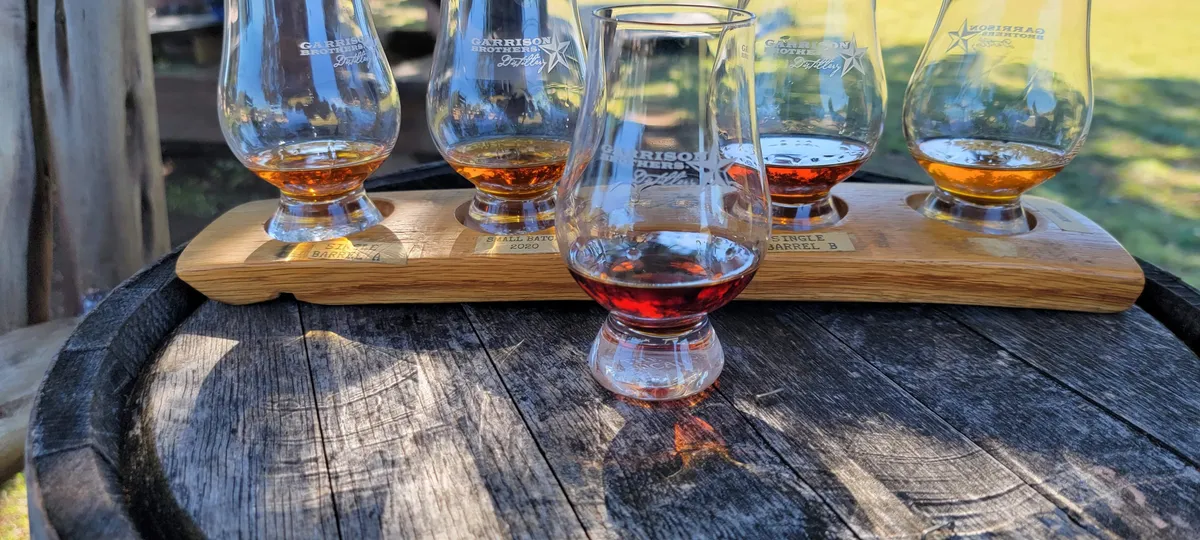
A tasting flight at Garrison Brothers Distillery in Hye, November 2021.
A sealed bottle of whiskey doesn’t go bad, and it doesn’t get better sitting on the shelf either. An open bottle changes slowly once air gets in. How slowly depends on who you ask, and the answers don’t agree.
Sealed bottles
Whiskey does its aging in the barrel, and that stops when it’s bottled. The Scotch Whisky Association says “Unlike wine, whisky does not mature in the bottle. So even if you keep a 12 year old bottle for 100 years, it will always remain a 12 year old whisky.” (Scotch Whisky Association)
It doesn’t spoil the way food does, either. Arran Distillery’s answer to the question is “no…at least in the sense of going sour like milk or developing a vinegar taste like wine,” and it says an unopened bottle stored properly “will last indefinitely.” (Arran)
Some collectors swear old sealed bottles taste different anyway. The Whisky Professor at scotchwhisky.com lays out both sides: “The official line is that whisky does not change in the bottle as long as that bottle remains unopened, but many collectors will argue that the opposite is the case.” He concludes, “Something happens but it happens slowly. What it is precisely? We are still not sure.” (scotchwhisky.com)
Open bottles
Once the seal is broken, air gets in and the whiskey starts to oxidize. Arran puts the fill level in it too: “The less whisky there is in the bottle, the more room there is for air to react with the liquid.”
They split on how long you have:
- Arran says that with the stopper pushed in tight, “your whisky should remain unchanged in flavour for several months to 2 years (as long as it’s at least half full).”
- Whisky Advocate says “consuming it within a few months will ensure that you are enjoying it at its peak.” (Whisky Advocate)
- The Scotch Whisky Association says that kept out of direct sunlight, “the Scotch Whisky will not deteriorate, even if it is opened.”
None of these gives a measured number for how fast an open bottle changes at a given fill level. Arran and Glenora do suggest the same fix for a low bottle. Arran says, “If the bottle is more than half empty, then it’s a good idea to transfer it to a smaller bottle.” Glenora gives the same advice once the level “drops significantly.”
Storing whiskey
The storage advice mostly lines up. Keep bottles upright; Glenora says it “prevents the high-proof alcohol from degrading the cork.” Keep them out of sunlight, somewhere cool that doesn’t swing much. Glenora puts the ideal at 15 to 20°C, 59 to 68°F.
What Dram+Vine does with it
I built Dram+Vine to tell me when a bottle wants drinking. A sealed whiskey has nothing to count down to, so the app doesn’t set a drink-by date for it on its own.
Mark a bottle open and the app starts the oxidation clock. How long it runs depends on how full the bottle is, which you update as you pour, and how strong it is. The countdown for each fill level follows published guidance on headspace: a bottle above half full keeps for years, one below half wants finishing within a year or two, and a nearly empty one gets the shortest clock of all. The adjustment for proof is my own call. Alcohol is what preserves whiskey, so the clock gives a bottle above 50% more time and one below 40% less, though none of these sources says proof changes how fast an open bottle fades.