The oxidation clock
I had always wondered why my keepsake bottles, the ones I only poured from now and then, started tasting flat towards the end. So I read up on how oxidation works in spirits and built a tracker into the app.
What is happening in the bottle
A sealed bottle of bourbon in 2026 is a sealed bottle of bourbon in 2036. Open it and the bottle starts changing. A 750ml bottle drawn down to half is holding about 375ml of air, roughly a fifth of it oxygen, and pulling the cork refreshes the supply.
That air works on the whiskey two ways. Oxygen reacts with the spirit, turning some of the ethanol toward acetaldehyde and then acetic acid, and pulling the brightness out of the esters. That part is slow. The faster part is evaporation. The volatile compounds carrying the nose lift into the headspace until the air above the whiskey is saturated with them, and when you open the bottle that loaded air goes into the room. Seal it again and the whiskey gives up another round to saturate the new air.
Both come back to the same two numbers. How much air is in the bottle, and how much alcohol is in the liquid.
The two numbers it can get at
How full the bottle is
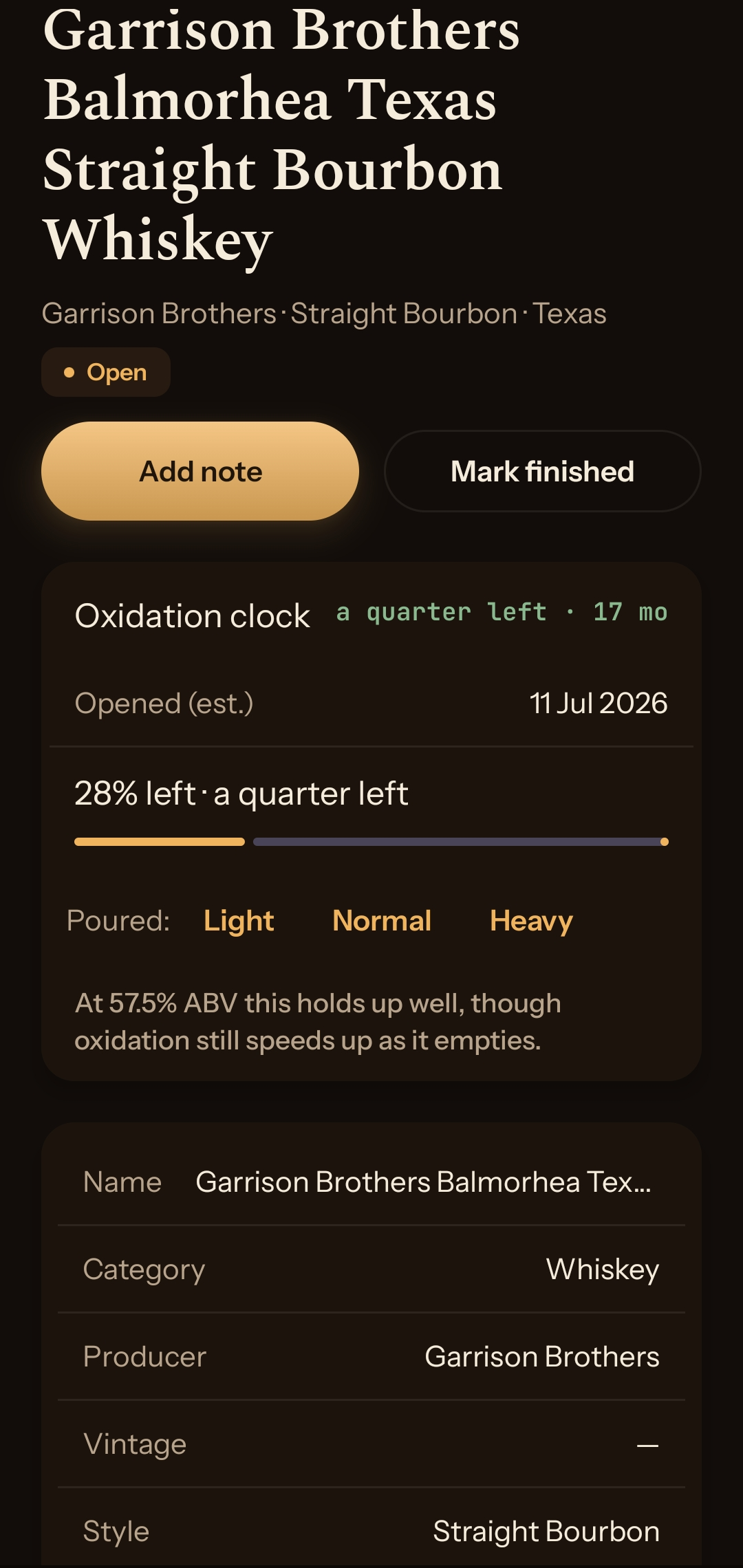
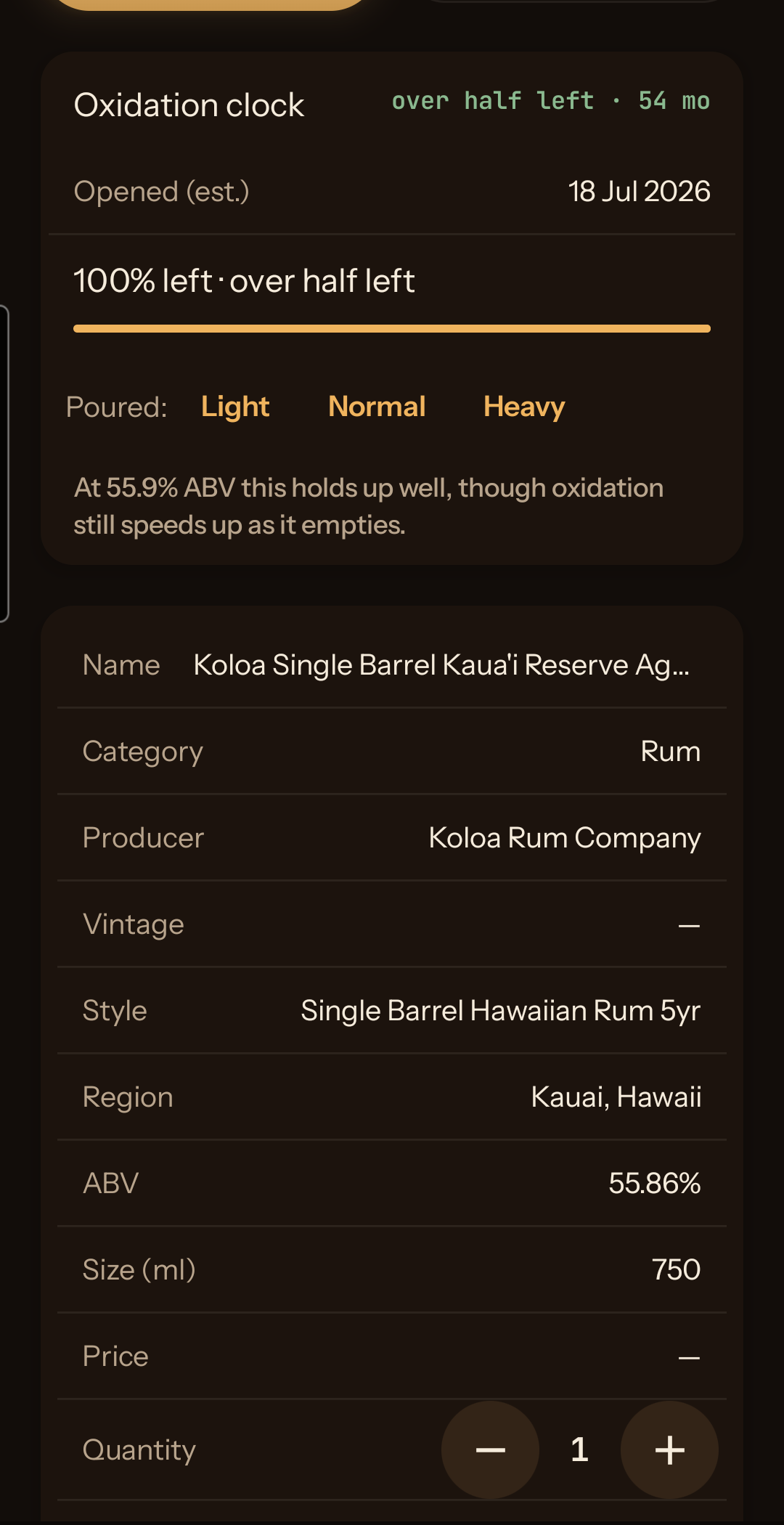
Every pour you log comes off the bottle. Light is 30ml, normal is 45ml, heavy is 60ml, which is roughly one ounce, an ounce and a half, and two. The app keeps a running total against the bottle size and works the fill out from that each time. It stores the running total; the band is worked out from it whenever you look.
If you've been drinking out of a bottle without logging any of it, tap the fill line and pick one of the four bands directly. Each one writes the middle of its band, so the number lands back in the same bucket you picked.
How strong it is
Alcohol is what's protecting the spirit. Below 40% ABV a bottle is vulnerable. Forty to fifty is standard. Above fifty it's robust and will outlast the other two by a long way. A cask-strength bourbon at 58% and a 35% liqueur are different problems.
ABV is a field on the bottle record, and often one the camera never got a clear look at. The clock leans on it, so it is worth checking on every bottle you add. Leave it empty and the app assumes the standard band, which will overstate the life of a 35% liqueur and understate a cask-strength bourbon. It comes up amber on the confirm screen whenever the label didn't read cleanly, and that is the moment to put the real number in.
The table
Where the two numbers cross is how many months the bottle has. Read down for how full it is, across for how strong. Where I set these thresholds is a judgement call, so here is all twelve of them to argue with.
| Fill level | Below 40% | 40 to 50% | Above 50% |
|---|---|---|---|
| Over half | 18 | 36 | 54 |
| Half to a third | 12 | 24 | 36 |
| A third to an eighth | 6 | 12 | 18 |
| Under an eighth | 1 | 2 | 3 |
It shows its working
Next to "finish within twelve months" the app shows which proof band it used to get there. If it misread the ABV off the label you can correct it and watch the date move.
Opening a bottle starts the clock. Buying a replacement and sealing it stops it. The deadline itself is never saved anywhere; the app works it out fresh from the bottle every time you look at it.
Finish it, or decant it
Ask whether you will finish the bottle before that date. If the answer is no, decant it as soon as you know. Pour what is left into a smaller bottle filled to the base of the neck, which cuts the headspace to a few millilitres and stops most of what remains from evaporating away. What has already gone does not come back. The app's record still describes the bottle you opened.
If you decant, the container matters. The surface where whiskey meets air is where the reaction happens, so a wide decorative decanter is worse than the bottle it came out of, and clear glass adds light to the problem. A plain amber bottle with a tight screw cap, filled almost to the top, is what you want.
The app gives you the date and the reasoning behind it.