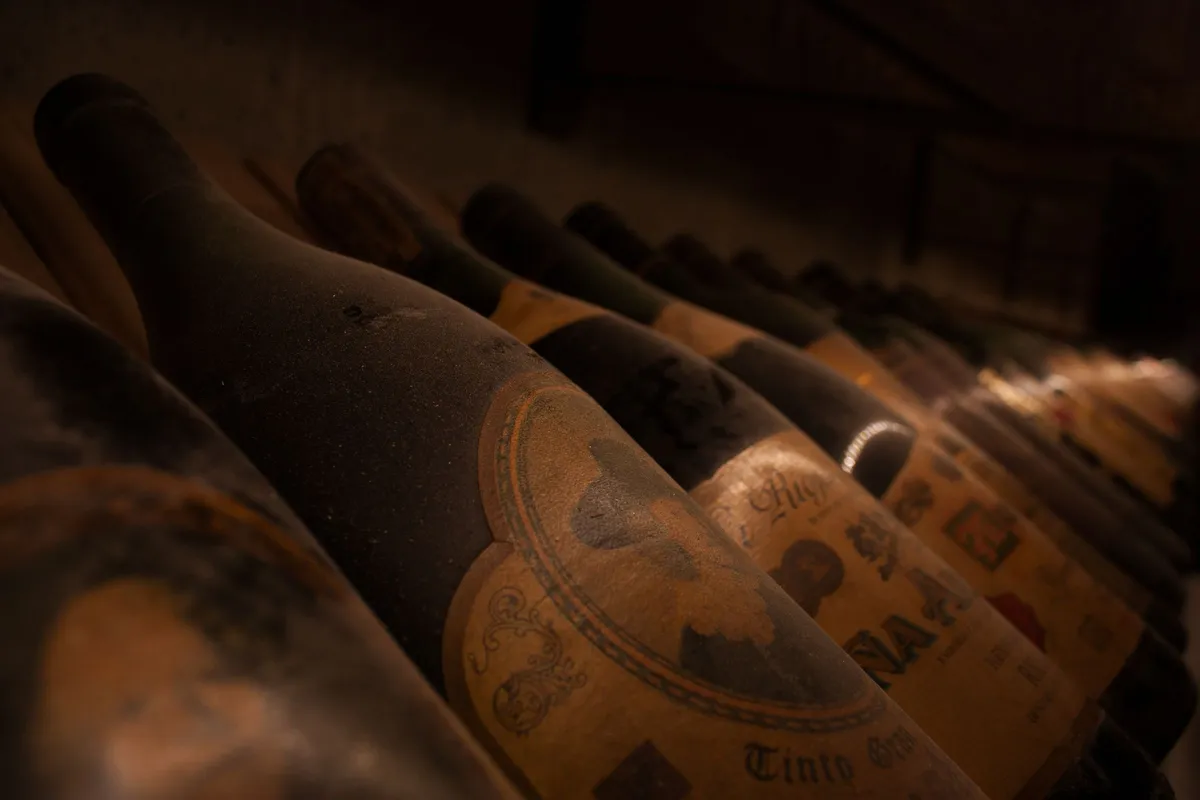
Photo by Javier Balseiro on Pexels
If you’ve ever opened a white you were saving for something special and found it flat, a little brown, and smelling more like sherry than wine, you’ve met the problem. It sat waiting and drifted past its window.
Sealed wine changes slowly in the bottle, and every bottle has a stretch of time when it’s at its best. After that, it fades.
Most wine is made to drink now
Wine Spectator’s Dr. Vinny puts it plainly: “I find that most wines in the market drink well upon release, and are best within a few years.” (Wine Spectator) The wines built for a long nap are the exception. Same page: “Wines that are built for aging are about as rare as people who truly have a taste for aged wine.”
Wine educator Kevin Zraly has put a number on it. As cited on Wikipedia, he estimates that 90% of wine is meant to be drunk within a year of production and 99% within five years. It’s an estimate, but it lines up with what Wine Spectator says.
By that measure, the everyday bottle you bought five years ago for a dinner that never happened may already be past its best.
What lets a wine age
Some wines do reward waiting, and Wine Folly lists the traits that give them the legs for it (Wine Folly):
- Acid. “Wines with higher acidity tend to last longer. As a wine ages it slowly loses its acids and flattens out.”
- Tannin. “Tannin acts as a structural component and red wines with higher tannins tend to age better than lower tannin red wines.”
- Sugar. Sweet wines like Sauternes and Riesling, along with port and sherry, are among the longest lived.
Alcohol cuts the other way in an ordinary table wine: “Alcohol is volatile in non-fortified wines and causes wine to turn to vinegar more quickly.”
You can watch the change in an older red. UC Davis’ Waterhouse Lab describes tannin slowly shifting the color, a change that “gradually changes the purple hue of a young wine to a brick red color; this is generally accompanied by a reduction in astringency.” (UC Davis)
What a drinking window is
A drinking window is the span of years a wine should taste its best. Wine Spectator says it “suggests when the wine is likely to be at its best” (Wine Spectator Help).
A window is an estimate: Dr. Vinny says “any given wine might under- or overperform in terms of ageability.” It also assumes the bottle was kept well: “Wine Spectator’s drink windows are already based on the assumption that the wine will be held in ideal storage conditions.” (Wine Spectator)
Heat shortens the window
The number you’ll hear for storage is 55°F. Wine Spectator says 55°F “is often cited as close to perfect,” and says “Temperatures higher than 70° F will age a wine more quickly than is usually desirable.” (Wine Spectator) Dr. Vinny goes further: “above 80° F you start to risk heat damage.” (Wine Spectator)
A technical note from the Australian Wine Research Institute cites a study that found faulty flavors developing after 12 months at 30°C, about 86°F, and says “Temperatures in excess of 40°C will induce visual and sensory changes to a wine in only a matter of days.” That’s 104°F. (AWRI)
That matters here in Central Texas, where I live. Austin averages about 123 days a year at 90°F or more and 28.7 at 100°F or more, per NOAA’s 1991 to 2020 climate normals (NOAA). A closet in an air-conditioned house isn’t a cellar. Dr. Vinny calls a closet fine for short-term storage, and by short term he means “inside of six months, and definitely not counting years.” (Wine Spectator)
Light shortens it too, especially for whites
A 2022 study in the journal OENO One measured how much of the damaging light gets through different bottle colors. Clear bottles let through up to 35% of it, and dark amber bottles up to 0.2%. The authors’ conclusion: “white wine in flint (clear) and bluish-green bottles can survive only for a few days while displayed on shelves; light amber bottles conserve the quality for about a month and dark amber bottles for more than a year.” (OENO One)
If your white is in clear glass, keep it in the dark.
Cork or screw cap
The closure decides how much oxygen gets into the bottle. The Australian Wine Research Institute ran a long closure trial on a 1999 Semillon, and its first results put screw caps out front: “Wine sealed with the screw cap retained the greatest concentration of SO2 and ascorbic acid, and had the slowest rate of browning.” (AWRI) The same trial found a rubbery note developing under the screw cap after 18 months, and concluded that “No one closure tested in this study could be considered entirely suitable by all criteria assessed, for the long-term storage of wine.”
Natural cork is the less predictable one. The AWRI says natural corks “can show high levels of variability in their permeability, depending on the grade of cork used,” while screw caps have “very low to low OTR values with a high degree of consistency,” OTR being how much oxygen gets through (AWRI). Good cork still holds up: in a separate 2018 AWRI tasting of red and white wines bottled under both closures, “the best-preserved cork-sealed bottles were the equal of the screwcapped versions.” (AWRI)
As for storing bottles on their side, Wine Spectator says you only need to bother for a cork you’re keeping a long while: for bottles you’ll drink “in the near- to mid-term, or if the bottles have alternative closures (screwcaps, glass or plastic corks), this is not necessary.” (Wine Spectator) A study published in the Journal of Agricultural and Food Chemistry in 2006 found “The bottle orientation during storage had little impact on oxygen ingress for most of the closures tested” (read from a copy hosted by a cork producer).
How to tell a bottle has gone over
- Oxidized. The Australian Wine Research Institute describes the slide as moving from a dulled aroma to “‘cardboard’, ‘straw’ and ‘hay-like’ aromas, to ‘sherry-like’ and ‘madeirised’” (AWRI).
- Cooked. Heat-damaged wine tastes stewed. Dr. Vinny: “The fruit flavors seem stewed instead of fresh, there can be a baked or burnt note, and the color can take on a more brownish hue.” He adds that “a leaking cork is a clear sign that the wine inside was overheated.” (Wine Spectator)
- Corked. That’s TCA, a contaminant that at higher levels makes wine “smell moldy or musty, like cardboard, damp cement or wet newspapers.” It comes from contamination, not from age, and Wine Spectator notes “TCA taint poses no health concerns for wine drinkers.” (Wine Spectator)
How Dram+Vine tracks the window
Every bottle in a rack has its own window, and nobody can hold all of them in their head, so I built Dram+Vine to do it.
Scan a wine label and the bottle gets first-pass drink dates, a drink-from year and a drink-by year. Re-check window runs it again and writes a fresh range with a line underneath saying why it landed there, and the app nudges you toward a re-check on bottles that look like long-cellar candidates. You can always set either year yourself. How it works shows the whole flow.
Then the app does the remembering. The Drink Soon screen sorts your bottles by days left, with anything already past its window in its own section, and the app sends you a heads-up ahead of time. By default that’s six months before the end of the window for a white, rosé or sparkling wine and a year ahead for a red, and you can change both in settings.