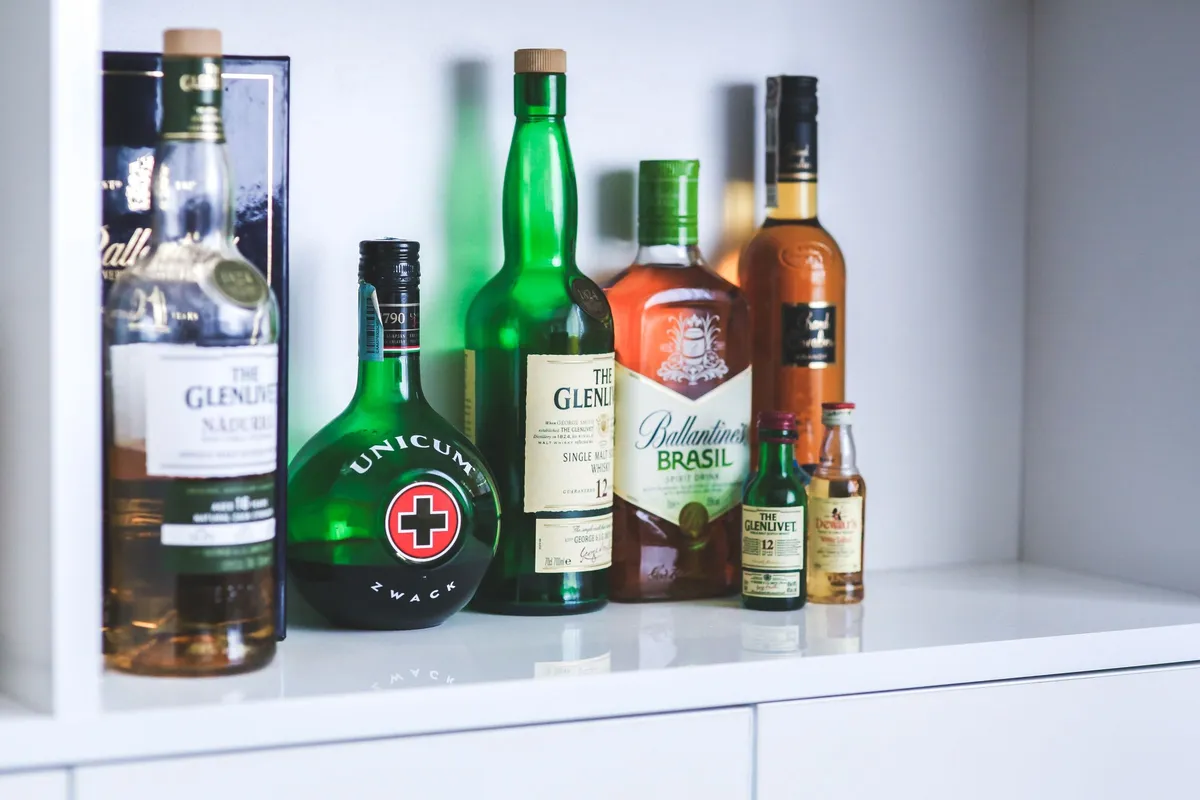
Photo by Karolina Grabowska www.kaboompics.com on Pexels
I first heard the word naggin when I met MeLinda. She was in an Irish pub rock band called The Naggins. MeLinda left the band years ago, but they still play around San Antonio regularly, and you should go check them out.
A naggin is also a bottle size, and it has company. A lot of liquor bottles go by slang, and a few of those names are wrong about how much is in the bottle.
| Name | Size | Where you’ll hear it |
|---|---|---|
| Nip, mini | 50 ml | US; “nip” mostly in New England |
| Half pint | 200 ml | US |
| Naggin | 200 ml | Ireland |
| Pint | 375 ml | US |
| Mickey | 375 ml | Canada |
| (no nickname) | 700 ml | UK; also legal in the US |
| Fifth | 750 ml | US |
| Two-six | 750 ml | Canada |
| Liter | 1 L | US and UK |
| Forty-ouncer, a forty | 40 oz | Canada |
| Handle | 1.75 L | US |
The naggin
In Ireland a naggin is a 200 ml bottle. Green’s Dictionary of Slang calls it “a small, flat ‘flask’ of spirits” (Green’s). The name is on the shelf there, too: when Jägermeister came out in the size there, the distributor launched it as a 20cl naggin (Drinks Industry Ireland).
The word probably goes back to the Irish naigín, a little wooden pail (Green’s). The Oxford English Dictionary, as cited on Wikipedia, defines it as usually one gill, a quarter of an imperial pint, which is less than today’s 200 ml bottle. Naggin is a variant of noggin, which Merriam-Webster still lists as a small drink.
The fifth, which isn’t
Ask for a fifth and you’ll get a 750 ml bottle. A fifth used to be one fifth of a US gallon, about 757 ml (Merriam-Webster), and that’s what the bottle held until 1980, when the US switched spirits to metric sizes (Federal Register). The bottle got a little smaller. Nobody changed what they called it.
The pint, which really isn’t
A liquor pint is a 375 ml bottle. A real US pint is about 473 ml (Merriam-Webster), so the liquor pint comes up short by a little more than a fifth of its own name. A half pint is 200 ml (NIAAA), against a real half pint of about 237 ml.
Before metric, there were a lot more sizes on the shelf. Aaron Goldfarb, writing about old bottles in his book Dusty Booze, says the 60s and 70s had “dozens of different-sized bottles. Pints and quarts and even gallons.” (Unicorn Auctions)
The liter
The liter goes by its own name. One-liter bottles are pretty common, and it’s one of the legal US spirits sizes (eCFR) as well as a UK one (GOV.UK). It holds a third more than a fifth.
The handle, which is exactly what it sounds like
A handle is the 1.75-liter bottle, and it’s called that because many of them have one. The Whiskey Wash says the name comes from the grip built into many bottles that size (The Whiskey Wash). It holds about 59 ounces, a little shy of a half gallon.
The nip
At the other end is the nip, the 50 ml bottle you get on an airplane or out of a hotel minibar (Bloomberg). Nip is New England slang (MEL Magazine), and it’s official enough that Massachusetts wrote the word into a bill about recycling them (Massachusetts Legislature). Elsewhere people might call it a mini or a shooter, if they call it anything.
Canada’s set
Canada has its own set.
- Mickey, 375 ml (Dialects of Ontario). It’s often assumed to be named after Mickey Mouse. It isn’t: the Dictionary of Canadianisms at UBC points out the word was in use before Disney’s character showed up in 1928 (DCHP).
- Two-six, 750 ml. It started out as a twenty-sixer, for the old 26-ounce bottle, and got shortened over the years (DCHP).
- Forty-ouncer, or a forty, a 40-ounce bottle (DCHP).
Odds and ends
If a bottle looks a little short next to your fifths, read the label. The UK’s legal spirits sizes include 700 ml and skip 750 (GOV.UK), and the US has allowed 700 ml since a 2020 rule (Federal Register) and still lists it today (eCFR).
And if you’re counting drinks, for 80-proof spirits NIAAA counts a nip as 1, a half pint as 4½, a pint as 8½ and a fifth as 17.
Where the size matters in Dram+Vine
When you add a bottle to Dram+Vine, it fills in 750 ml, and you change it to whatever’s on the label. Once the bottle’s open, every pour comes off that number to work out how full it is, and that drives the oxidation clock. A 60 ml pour barely dents a handle. Out of a pint, it’s a real bite.